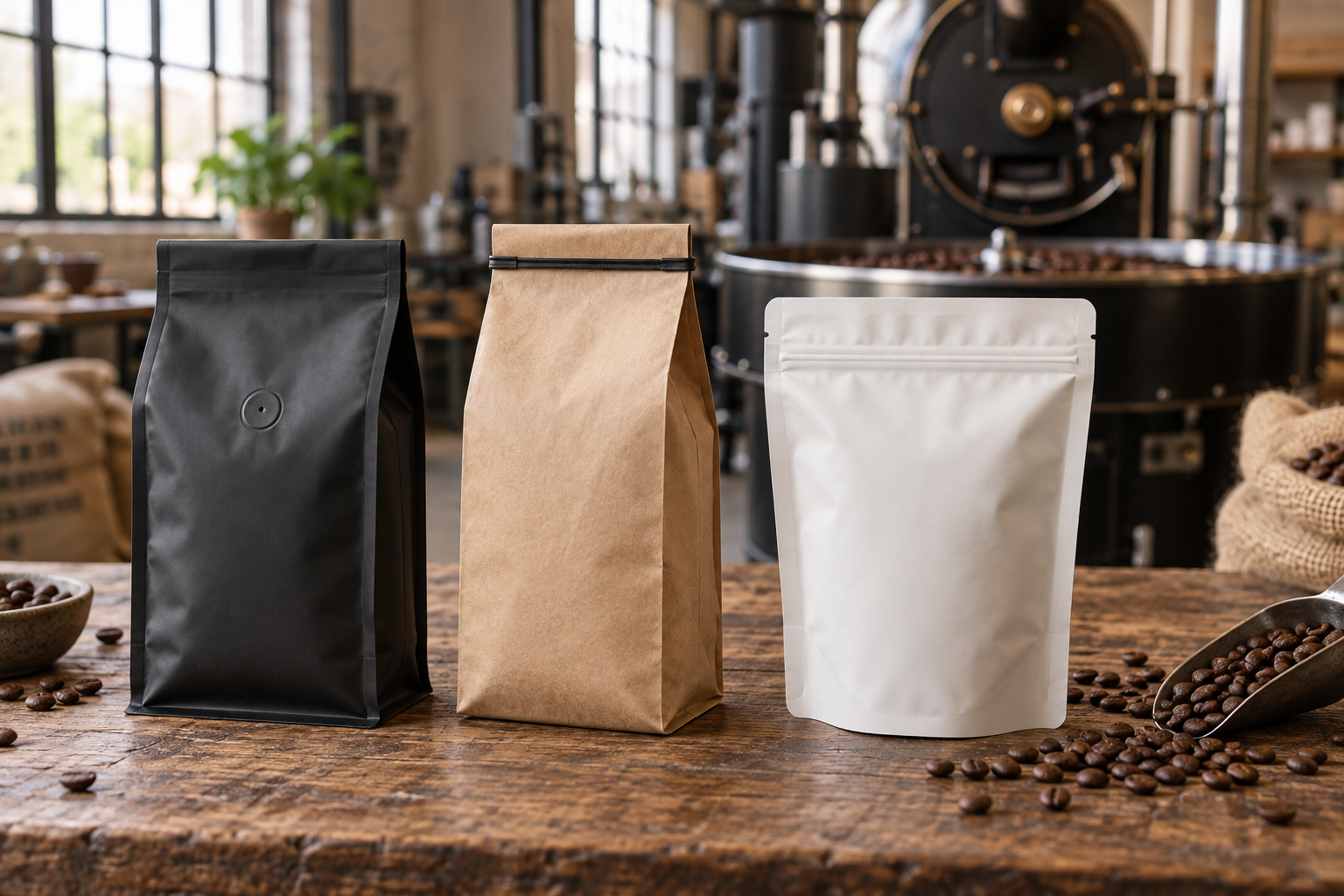

01Why coffee needs to degas
Roasted coffee is chemically active. In the first 48 hours after roasting, beans release carbon dioxide at a rate of roughly 5–10 mL per gram. For a 12 oz (340 g) retail bag, that's up to 3.4 litres of gas looking for a way out.
Without a valve you have two bad options: seal the bag airtight and watch it inflate like a pillow on the shelf — or leave beans to rest for days before packing, while oxygen quietly degrades the aroma your roaster worked to build.
02How the valve actually works
A one-way degassing valve is a small plastic disc — typically 20 mm across — heat-sealed into the bag wall. Inside, a thin silicone membrane sits over a vent hole:
- Pressure inside > outside: the membrane lifts, CO₂ escapes.
- Pressure equalizes: the membrane seals shut, blocking oxygen and moisture from entering.
- No aroma loss: the valve opens only under positive pressure, so volatile aromatics stay in the bag.
03What to specify when ordering
Valves are not all equal. When you request a quote, these are the specs our engineers will confirm with you:
| Spec | Common Option | Notes |
|---|---|---|
| Valve type | One-way, with filter | Filter keeps coffee dust off the membrane |
| Placement | Front face, upper third | Away from the fill line and seal jaws |
| Application | Inline, during bag making | No secondary process, no extra lead time |
| Compatibility | Kraft / foil / PLA structures | Verified seal on compostable films too |
Key Takeaway
If you pack coffee within 7 days of roasting, a one-way degassing valve is not optional — it's the difference between a fresh, shelf-stable product and a ballooning bag. Cost: about $0.01 per bag. Lead time at Spuntree: none, applied inline.
04Do all coffee bags need a valve?
Whole bean, packed fresh: yes, always. Ground coffee: still recommended — grounds degas faster. Instant coffee or tea: no valve needed; a standard high-barrier seal is enough.
When in doubt, send us your product and packing timeline — we'll spec it in one email.