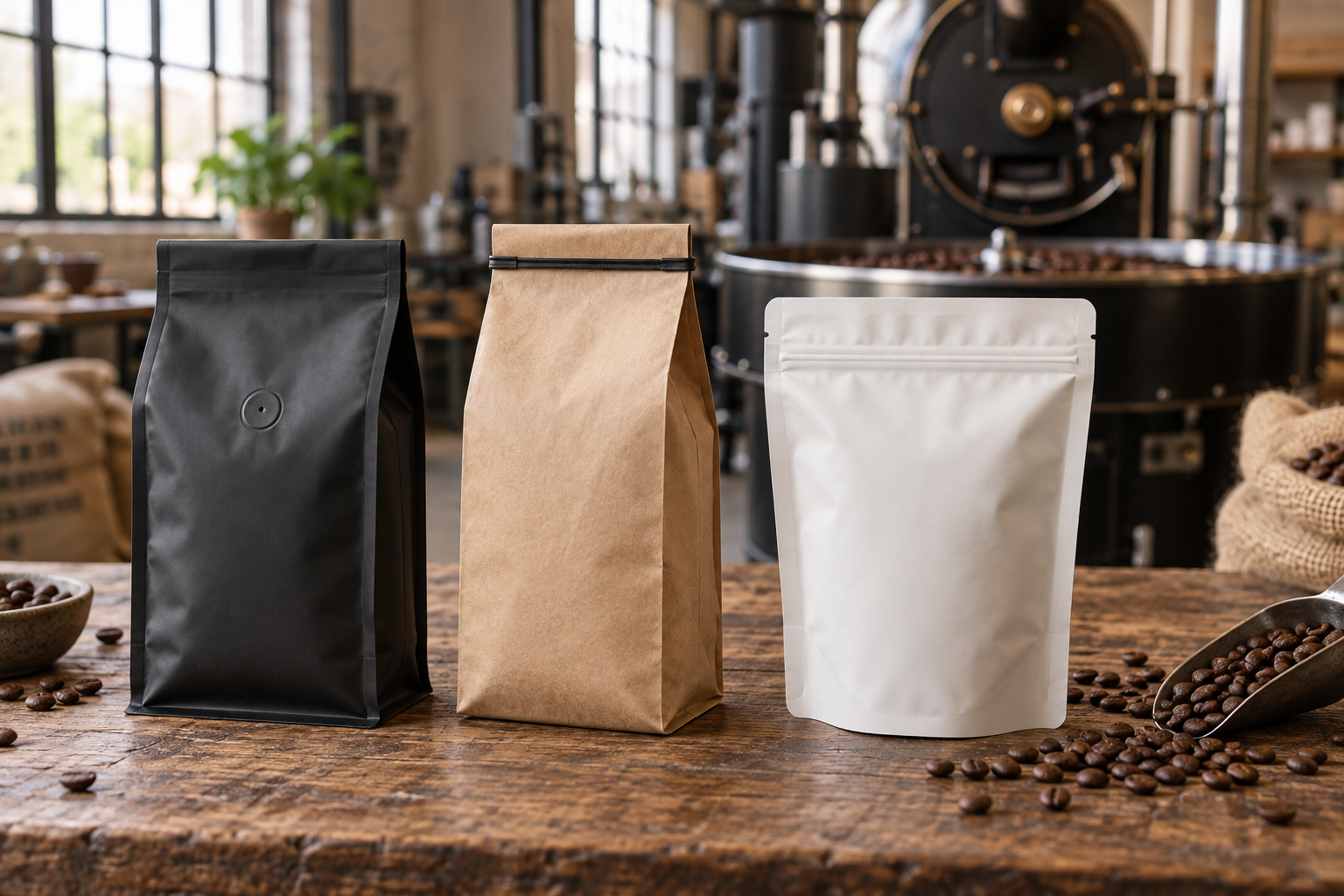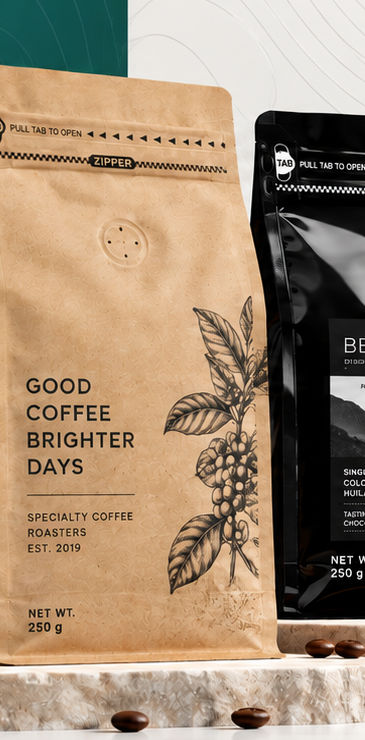
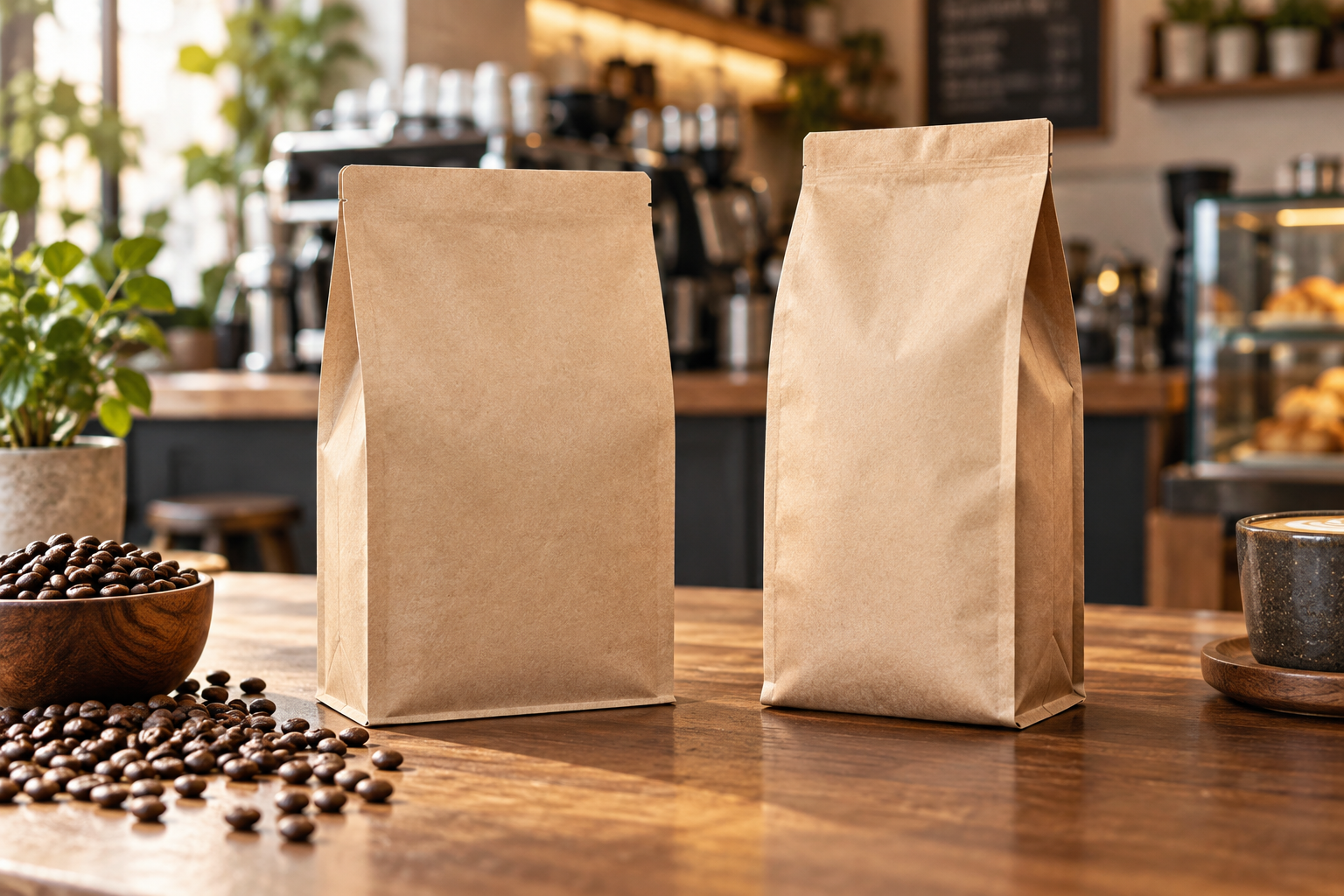
Ask ten coffee roasters which bag format they use and why, and you will hear strong opinions in both directions. Flat bottom bags dominate specialty retail shelves; side gusset bags still fill the back rooms of high-volume roasteries. The real answer to "which is better" is the least satisfying one: it depends on your volume, channels, and brand positioning — and the trade-offs are more concrete than most comparisons admit.
This article compares flat bottom and side gusset coffee bags across the six dimensions that actually matter in production and on the shelf, drawing on what we see across both formats in day-to-day manufacturing.
Quick Comparison
| Dimension | Flat Bottom Bags | Side Gusset Bags |
|---|---|---|
| Shelf presence | Excellent — stable base, 4 print faces | Good — narrower front panel |
| Material usage | Higher (~15–30% more film) | Lower |
| Unit cost | Higher | Lower |
| Filling line compatibility | Good; needs stable base handling | Excellent; long track record on volumetric and auger fillers |
| Stacking & shipping | Cubic, palletizes well | Fills compactly, slightly softer packs |
| Typical positioning | Specialty / premium retail | Volume, wholesale, classic roaster look |
1. Structure: How the Two Bags Are Built
Flat bottom bags — also called box pouches or quad seal bags — are formed from a single web of laminated film into a rectangular box shape with four vertical heat seals and a flat bottom panel. The result stands without support and presents four near-flat printable faces: front, back, and two narrow side panels.
Side gusset bags are the traditional coffee roaster bag: a tubular bag with a folded gusset on each side that expands as the bag fills, finished with a fold-over or heat-sealed top. When filled, the gussets open to give the bag a rectangular footprint.
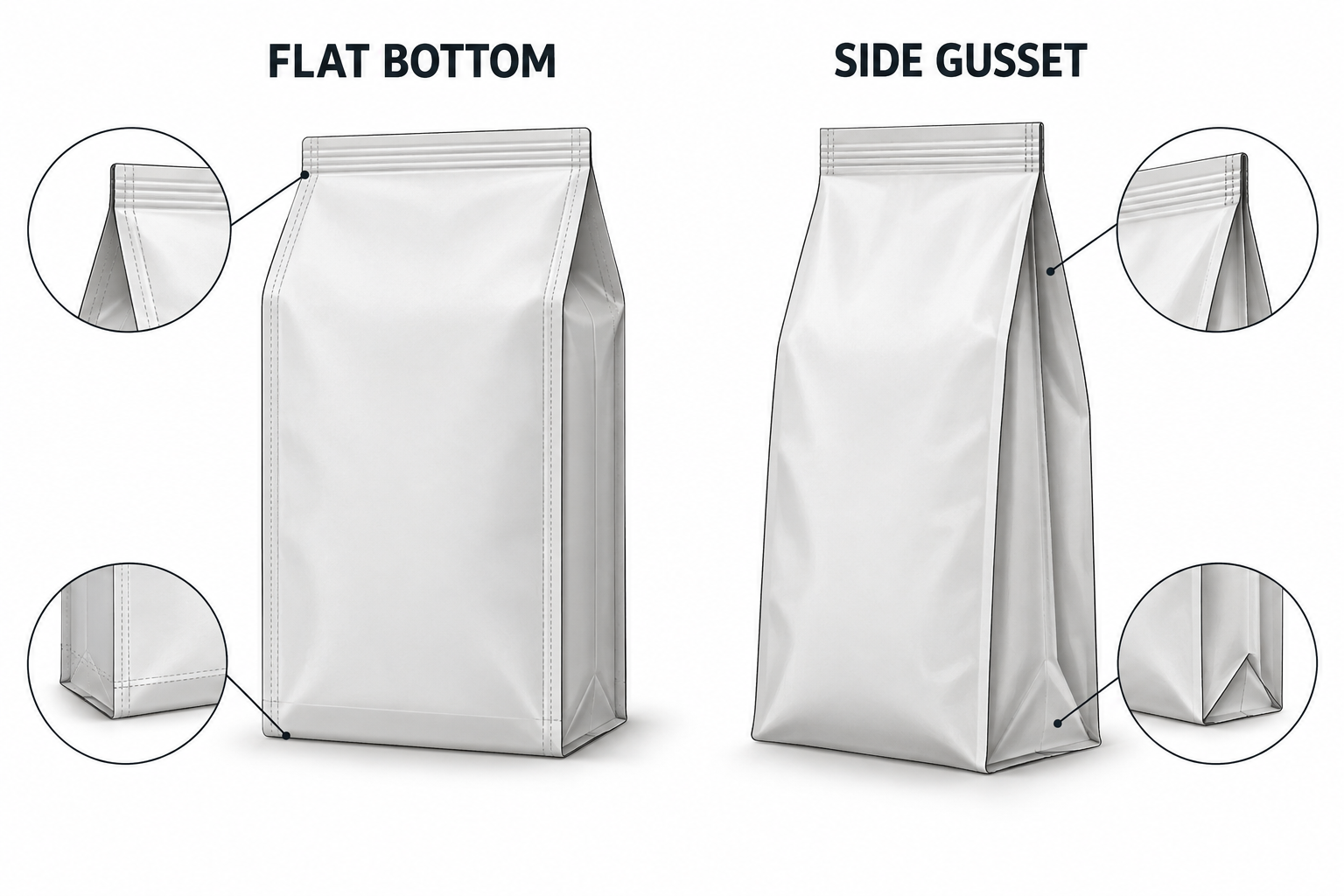
The structural difference sounds small but drives everything else: the flat bottom bag uses more film and more sealing operations (four seals plus bottom), while the side gusset bag is one of the most material-efficient premium formats ever designed.
2. Shelf Presence and Branding
This is where flat bottom bags earned their dominance in specialty coffee. A flat bottom bag stands rock-steady, shows a full-width front panel, and offers two additional side panels for storytelling, tasting notes, or brewing instructions. On a crowded specialty shelf, that extra print real estate is genuinely valuable — third-wave brands often treat the bag as their primary branding surface.
Side gusset bags present a narrower front panel once filled, because the gussets pull material to the sides. Skilled design work compensates: strong central typography, a colored side gusset print, or a full-bleed design that wraps around the filled bag all work well. Many heritage roasters actually prefer the classic roaster-bag look — it signals tradition rather than limitation.
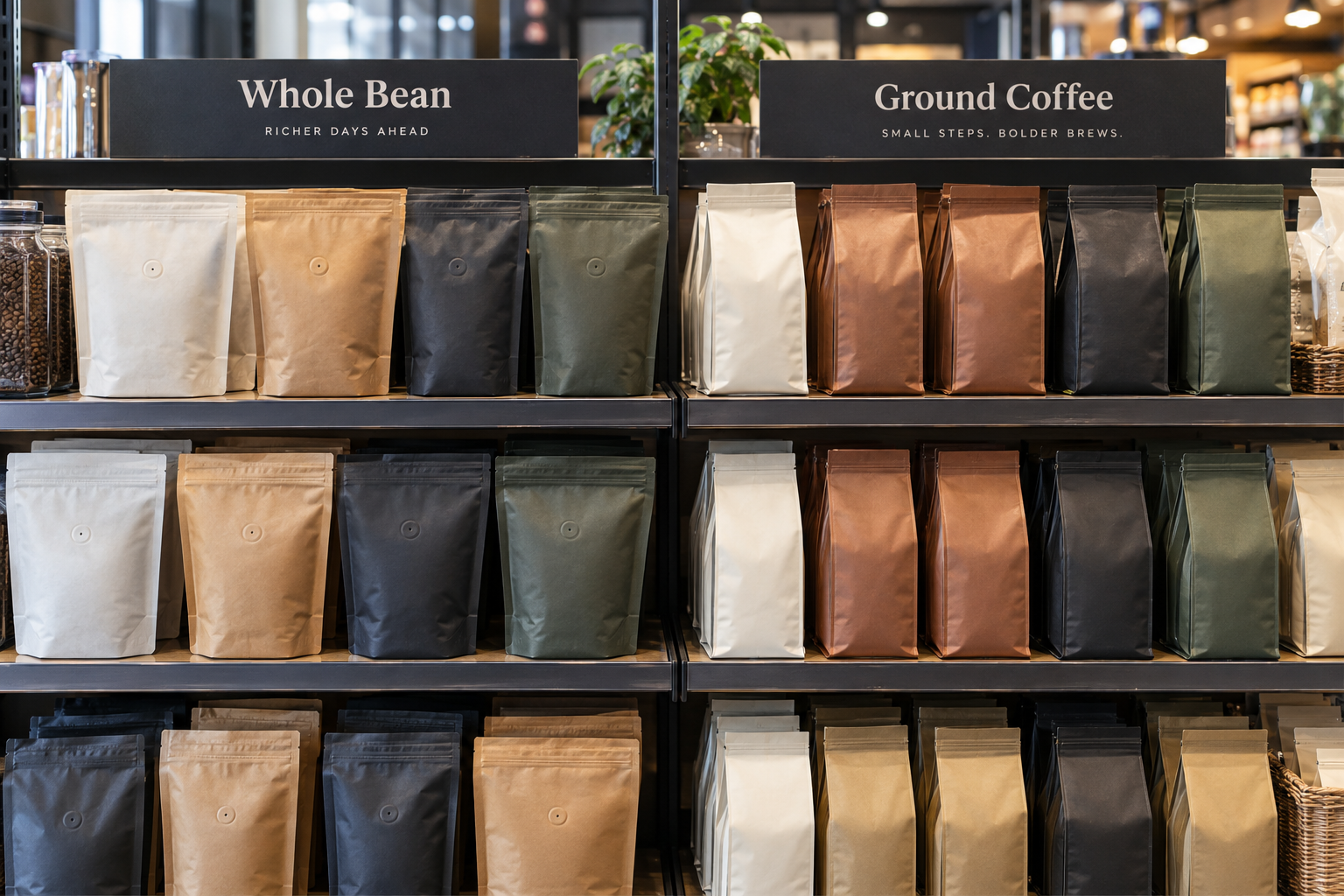
Practical design note: on side gusset bags, remember that a portion of the printed front panel disappears into the gusset folds when the bag is empty. Critical elements (logo, weight statement, barcode) should sit inside the "safe zone" that remains visible on the filled bag — a detail we check in every pre-production artwork review.
3. Cost: Film, Production, and Total Cost of Ownership
Flat bottom bags typically use 15–30% more laminated film than an equivalent side gusset bag, depending on size and gusset depth. Add the extra sealing operations and slightly slower bag-making speeds, and the unit cost gap is real — commonly in the range of 15–25% at the same structure and print coverage.
But unit price is not the whole picture. Consider total cost in use:
- Filling speed and waste. Side gusset bags have decades of filling-line optimization behind them; they run fast and waste little. Flat bottom bags run well on modern equipment but older volumetric fillers may need adjustments for the rigid base.
- Shipping cube. Flat bottom bags pack into near-perfect cubes on a pallet, which can improve carton utilization and reduce freight damage.
- Retail acceptance. Some specialty retailers and chains prefer or effectively require the flat bottom format for shelf sets — a commercial factor worth checking before committing to either format.
4. Freshness Performance: Barrier and Seals
Here is a truth that surprises some buyers: the bag format itself has almost no effect on freshness. What protects coffee is the barrier structure (PET/foil/PE or equivalent) and the integrity of the seals. A side gusset bag with a foil barrier and strong seals outperforms a flat bottom bag with a weak barrier every time.
Where format does matter is seal geometry:
- Side gusset bags carry a long back seam plus a top fold or seal. The back seam is a single critical line — easy to inspect and test, and well understood by every bag maker.
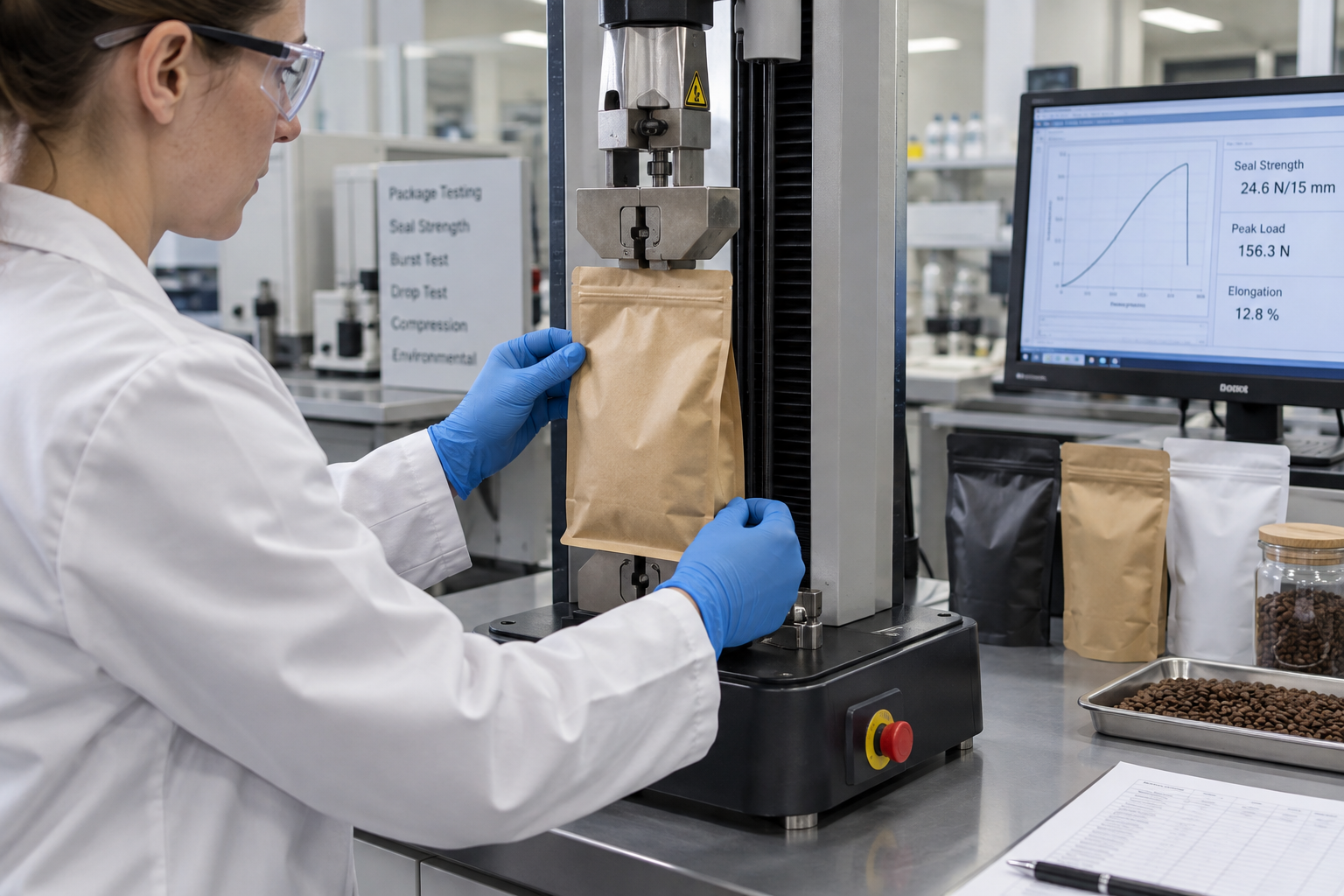
- Flat bottom bags have four corner seals plus a bottom panel seal. Modern bag-making machines form these consistently, but the seal area per bag is larger, so seal parameters (temperature, pressure, dwell time) must be dialed in carefully. In factory testing, we apply the same burst and seal-strength checks to both formats, sampling every production batch — and the data shows both formats reach full barrier performance when seals are properly formed.
The takeaway: judge freshness by the laminate specification and the supplier's seal QC, not by the silhouette of the bag.
5. Filling, Handling, and Equipment Fit
Before choosing a format, confirm it works with your equipment:
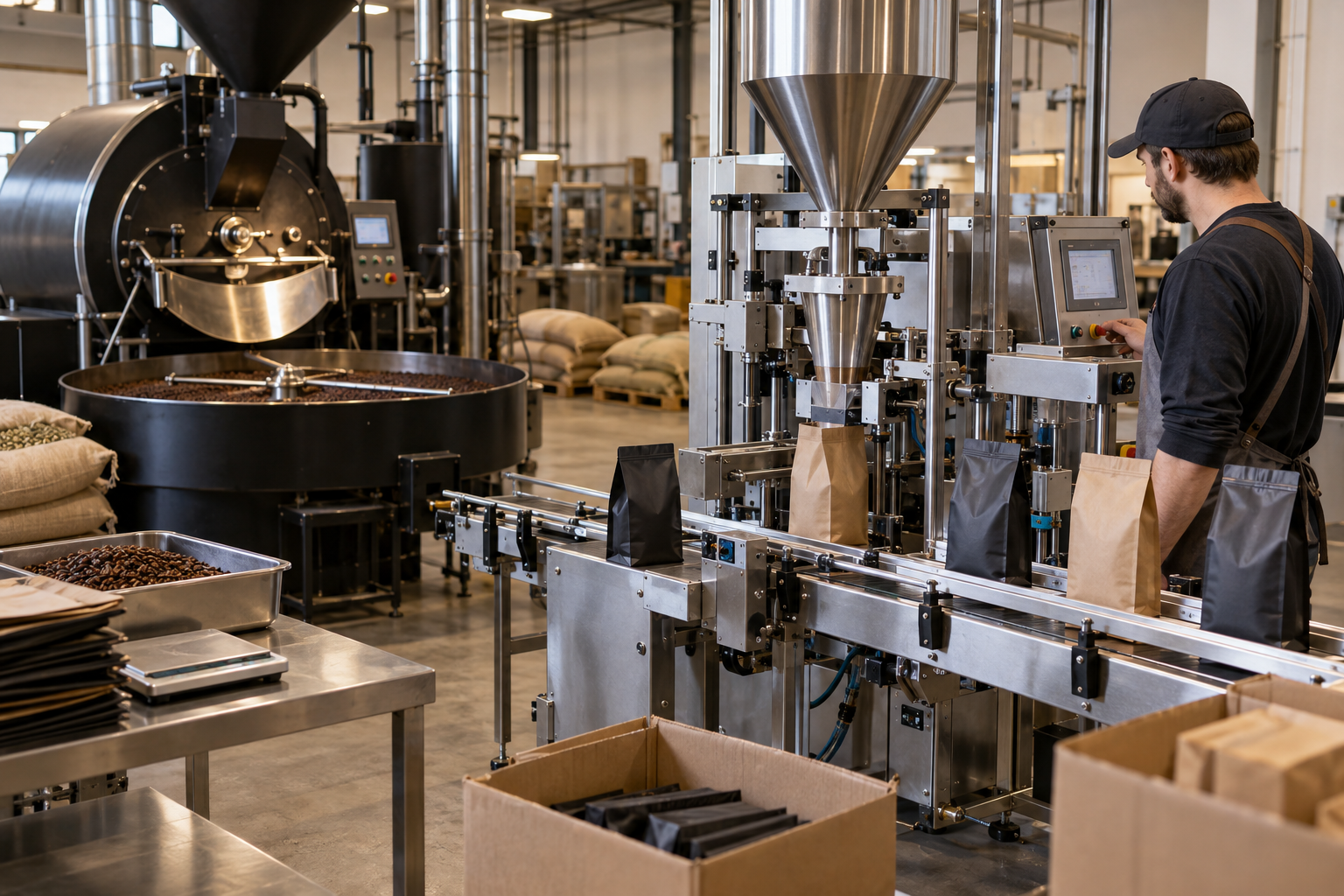
- Volumetric and auger fillers: both formats run well; side gusset bags have the longer track record.
- Automatic form-fill-seal for pre-made bags: flat bottom bags are widely supported on modern premade pouch machines.
- Manual and semi-manual filling: side gusset bags are slightly easier to hold open by hand; flat bottom bags can be filled standing on a scale, which some small roasters prefer.
One more operational detail: valve placement. Center-face placement is standard on flat bottom bags. On side gusset bags, the valve usually sits on the front panel above the fill line — placement must account for how far the gusset expands, or the valve can end up too close to the coffee surface.
6. Which Should You Choose? A Decision Framework
Choose flat bottom bags if:
- Your primary channel is specialty retail, where shelf presence drives purchase.
- Your brand story needs more print area than one front panel provides.
- Your volumes justify the unit cost difference (typically from ~5,000–10,000 bags per design).
- Your filling equipment supports the format.
Choose side gusset bags if:
- You ship high volume and unit cost efficiency matters.
- You sell through wholesale, food service, or online channels where shelf blocking is less critical.
- You prefer the classic roaster aesthetic.
- You run older filling equipment optimized for this format.
Consider running both. Many growing roasters use flat bottom bags for retail-facing SKUs and side gusset bags for wholesale sizes — same artwork system, two formats. From a manufacturing standpoint, this is straightforward, and it keeps your brand consistent while matching format to channel.
Real-World Notes From Production
Two observations from the factory floor that rarely make it into comparisons:
Gusset depth matters more than buyers expect. On side gusset bags, a deeper gusset makes a bag that looks small on the shelf but holds full volume; a shallower gusset looks fuller but stacks less stably. We usually prototype two or three gusset depths with actual coffee before locking dimensions.
Empty-bag storage differs. Flat bottom bags ship flat-packed and cube-efficiently; side gusset bags pack even tighter. If warehouse space is tight at your roastery, both formats are friendly — but confirm carton dimensions with your supplier, as oversized cartons waste pallet space on ocean freight.
Sustainability and Compliance Considerations
One more lens worth applying before finalizing your choice: where the bag ends up after use. Regulations are tightening — extended producer responsibility (EPR) schemes in the EU and several US states now push brands toward recyclable mono-material PE or PP structures. Both flat bottom and side gusset bags can be produced in recyclable mono-material versions, with a modest barrier trade-off that must be validated against your shelf-life target.
If you market sustainability claims on the bag itself ("recyclable," "compostable"), verify the claim against actual end-of-life infrastructure in your target markets — a claim that fails local scrutiny is a reputational risk, not a marketing asset. Compliance labeling (material identification marks, disposal instructions where mandated) should be planned into the artwork layout from the start, alongside the regulatory elements mentioned earlier.
FAQ
Are flat bottom coffee bags more expensive than side gusset bags?
Yes, typically 15–25% more per unit at the same size and structure, mainly due to higher film usage and additional sealing operations. At large volumes, that difference is worth modeling against shelf-presence benefits.
Which bag format keeps coffee fresher?
Neither — freshness is determined by the barrier laminate and seal integrity, not the bag shape. Both formats perform equally when built with the same film structure and properly tested seals.
What size flat bottom coffee bags are most common?
250 g and 340 g (12 oz) are the most common retail sizes, followed by 500 g and 1 kg for larger retail or light wholesale use. Side gusset bags commonly extend further into the 2–5 kg range.
Can I print the same design on both formats?
You can share the design system (colors, typography, key graphics), but each format needs its own dieline and artwork adaptation — panel dimensions, gusset zones, and safe areas differ.
What is the MOQ for custom flat bottom coffee bags?
Custom-printed flat bottom bags typically start around 5,000–10,000 units per design with rotogravure printing; digital printing supports much lower volumes at a higher unit cost.
Do flat bottom bags need a degassing valve?
Only if you pack freshly roasted coffee. The valve decision is driven by roast-to-pack timing and CO₂ release, not by bag format — both formats take valves equally well.
Conclusion
Flat bottom and side gusset coffee bags are both mature, proven formats. Flat bottom bags buy you shelf presence and print area at a higher unit cost; side gusset bags buy you material efficiency and filling-line heritage at a smaller branding canvas. Neither protects coffee better — the laminate and the seals do that work.
The right choice is the one that matches your channels, volumes, and equipment — and the most reliable way to decide is to put both formats on your filling line with actual coffee before committing to a production run.
See Both Formats With Your Own Artwork
Spuntree manufactures custom flat bottom and side gusset coffee bags with foil or recyclable barrier structures, printed to your design. Send us your bag size, target volume, and artwork draft, and we will produce sample bags in both formats so you can compare them on your shelf and your filler — before you order. Request samples and a quote.